

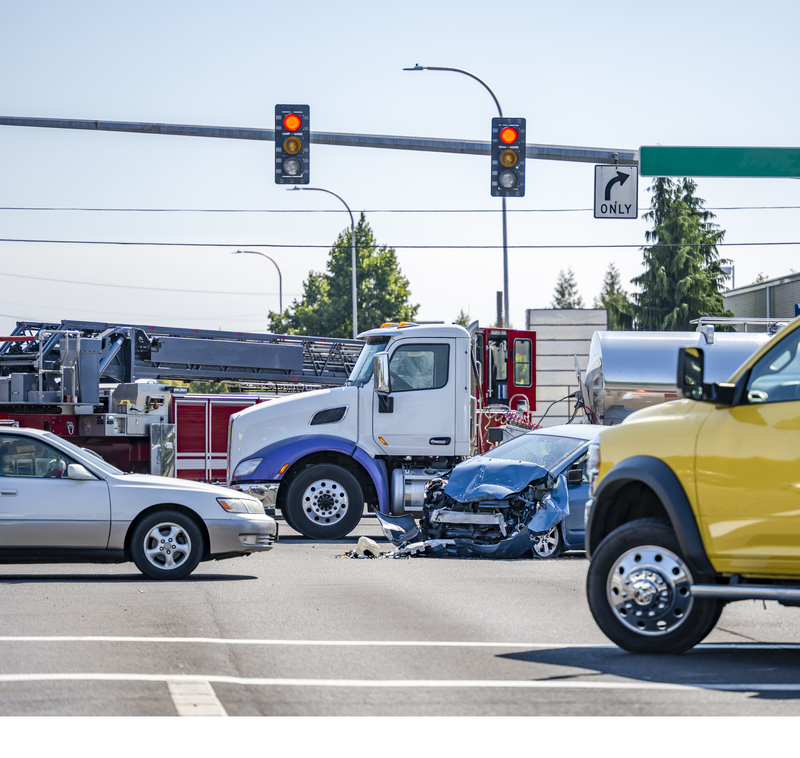
When a passenger vehicle is involved in a collision with an 80,000-pound commercial vehicle, the legal aftermath is more than “just another car accident claim.” At GB Legal, we see firsthand how the stakes shift when big trucks are involved. Trucking litigation is a specialized field that operates under a different set of rules, higher stakes, and more complex evidence than standard personal injury cases. Here is why big truck litigation is in a category of its own.
The “Black Box” and Digital Evidence. Unlike most passenger cars, commercial trucks are equipped with an Electronic Control Module (ECM), often called a “black box.” This device records critical data at the time of a collision, including speed, braking patterns, and throttle position. In addition to the ECM, we look for:
– Electronic Logging Devices (ELDs): These track how many hours a driver has been behind the wheel to ensure compliance with federal fatigue laws.
– Dashcam Footage: Many fleets now utilize dual-facing cameras that capture both the road and the driver’s behavior.
Maintenance Logs: These can prove if a mechanical failure, such as worn brake pads, was the result of corporate negligence.
A Web of Federal Regulations. While standard drivers only need to follow the rules of the road, the trucking industry is governed by the Federal Motor Carrier Safety Administration (FMCSA). These regulations dictate everything from how many hours a driver can work without a break to the specific way cargo must be secured. Proving a violation of these federal mandates can often be the “smoking gun” that establishes negligence.
Multiple Liable Parties. In a typical car accident, you are usually looking at the other driver. In truck litigation, the circle of liability is much wider. Depending on the cause of the crash, the responsible party could be:
– The Trucking Company: For hiring unqualified drivers or forcing them to meet dangerous deadlines.
– The Cargo Loader: If shifting weight caused a rollover.
– The Maintenance Contractor: If a third party failed to repair the vehicle correctly.
– The Manufacturer:** If a defective part (like a tire or steering component) caused the wreck.
Higher Insurance Limits and Aggressive Defense. Because of the catastrophic potential of these accidents, federal law requires commercial trucks to carry significantly higher insurance limits – often in the millions of dollars. Because the financial exposure is so high, trucking companies and their insurers often have “rapid response teams” of investigators at the scene before the vehicles are even towed.
Catastrophic Injury Physics. The sheer mass of a semi-truck means the injuries sustained by passenger vehicle occupants are often life-altering. We aren’t just looking at medical bills from the ER; we are calculating the cost of a lifetime of specialized care, home modifications, and lost earning capacity.
We represent people injured as a result of the careless and reckless acts of others. At the end of the day your case can only be settled one time and you need to know all of the facts beforehand. Insurance companies have paid our clients hundreds of millions of dollars in compensation because we uncover the facts. When insurance companies fail to offer full compensation we are not intimidated at the prospect of going to trial. We help with serious injuries that require serious representation. We are the Law Offices of Guenard & Bozarth, LLP. Our attorneys have more than 60 years of experience specializing in only representing injured people. Call GB Legal 24/7/365 at 916-714-7672 or visit www.gblegal.com