

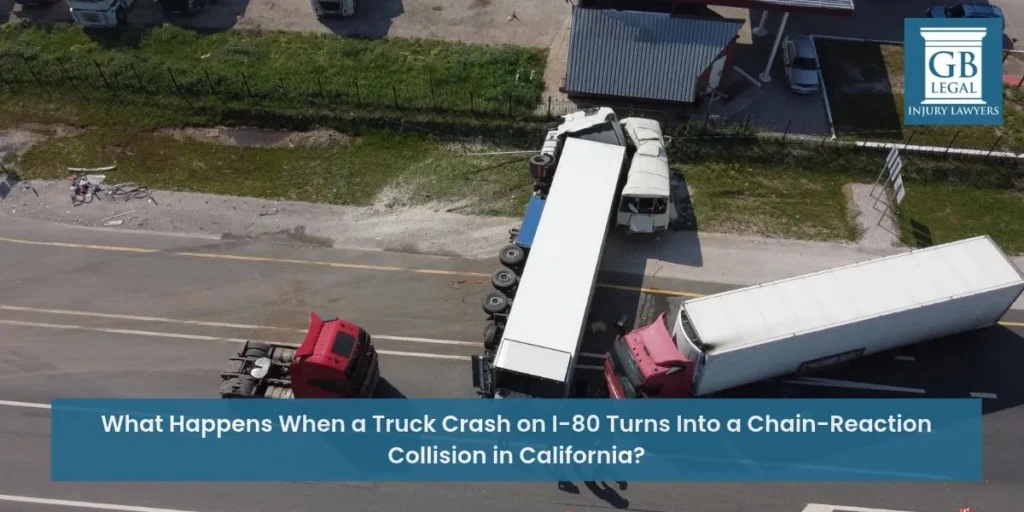
When an I-80 truck accident turns into a chain-reaction collision, you may be dealing with injuries, a damaged car, and several insurance companies that each have a reason to place the fault on someone else. That’s frightening, and it’s also a situation California law has rules for.
Fault gets divided by percentage among every driver and company that contributed, and you can seek compensation from more than one of them even if you can’t say which impact caused which injury.
At Guenard & Bozarth, LLP, Glenn Guenard has spent over 38 years representing badly injured people in Elk Grove, Sacramento, and across Northern California. Consultations are free, and you don’t pay a fee unless we recover compensation for you.
Who Is at Fault in a Chain-Reaction Truck Crash on I-80?
More than one party can share fault in a chain-reaction truck crash on I-80. Depending on what the evidence shows, that may include the truck driver who didn’t slow for stopped traffic, a driver who tailgated, the carrier that set the delivery schedule, and in some cases a shop that serviced the brakes. Winter tule fog over the Yolo Causeway cuts visibility fast, and a driver who holds highway speed in it may be found negligent for driving too fast for conditions.
The California Highway Patrol (CHP) writes the traffic collision report, and as a party of interest you can request a copy. An I-80 truck accident attorney can also pull the carrier’s inspection and crash history from the Federal Motor Carrier Safety Administration’s (FMCSA) SAFER system.
How Does California Divide Fault and Damages Between Several Drivers?
California divides fault by percentage under comparative negligence, so a chain-reaction collision is sorted into shares of responsibility, and if any share is assigned to you, your recovery is generally reduced by that percentage and may still be available.
Medical Bills and Lost Income
California Civil Code section 1431.2, passed by voters as Proposition 51 in 1986, keeps economic damages joint. Any at-fault defendant can be made to pay your full medical bills and lost wages and then collect shares back from the others, so an uninsured driver in the pileup doesn’t automatically leave you short.
Pain and Suffering
Non-economic damages work differently. If a jury values your pain and suffering at $400,000 and puts 60 percent of the fault on the trucking company, that company owes $240,000 of it, and each other defendant owes only its own share. Any share of fault placed on a driver with no insurance may be harder to collect, which is why identifying every available source of coverage matters.
Why Does the Order of Impacts Matter for Your Injuries?
The order of impacts decides which insurer pays for which injury. Most people in a chain-reaction truck crash get hit twice, once from behind and again when their car is shoved into the one ahead, and the front vehicle’s insurer may argue that your injuries came from that second hit rather than the truck. Early ER notes that record what you felt after each impact can separate the two, so describe both to the paramedics.
What Evidence Disappears Fastest After a Multi-Vehicle Truck Crash?
Driver logs, the truck’s onboard data, and video footage are the three kinds of evidence that disappear fastest after a multi-vehicle truck crash, and the trucking company controls most of it.
- Driver logs and dispatch records, which carriers must keep for only six months under 49 CFR 395.8.
- The truck’s electronic control module, which can record speed and braking in the seconds before impact and can be overwritten once the truck is back on the road.
- Dashcam footage from the truck and nearby cars, along with video from businesses near the scene, which is routinely recorded over.
A written preservation letter sent to the carrier puts it on notice to keep all three, and the sooner it goes out the better the odds that anything is left to preserve. Our attorneys at Guenard & Bozarth can send that letter for you, and the first consultation is free.
How Much Insurance Does a Commercial Truck Carry?
Most for-hire freight trucks must carry at least $750,000 in liability coverage under federal rules, and large carriers often carry more. That limit applies per crash, not per person, so six or eight injured people in a chain reaction are all drawing on the same pool. Your own uninsured motorist coverage, the other drivers’ policies, and any excess policy the carrier holds can add to it, and that is the main reason to identify every defendant before you sign a release. Because the available coverage can be limited, an insurer may offer a settlement early, before the full picture of your medical costs is clear.
How Long Do You Have to File a Claim After an I-80 Crash?
In most cases, you have two years from the crash date to file a personal injury lawsuit in California, under Code of Civil Procedure section 335.1. A suit over a collision in Sacramento County can be filed in Sacramento County Superior Court, though evidence like driver logs and vehicle damage may be gone long before that point.
Guenard & Bozarth offers free consultations at our Elk Grove and Sacramento offices, and an I-80 truck accident attorney on our team can review your crash report and tell you which deadlines apply to you.
Frequently Asked Questions
Does the insurance minimum change if the truck was hauling hazardous materials?
It does. Federal rules set the minimum at $1 million for oil and most hazardous materials and $5 million for certain bulk loads, compared with $750,000 for ordinary freight. If you saw a diamond-shaped placard on the trailer, that detail matters, since the shipping papers show which level applies.
Can I sue the trucking company if the driver was an independent contractor?
Often, yes. Under the Federal Motor Carrier Safety Regulations, a carrier that leases a truck takes on responsibility for operating it, so the contractor label rarely protects the company. Your attorney can request the lease agreement and dispatch records to show who controlled the run.
Can a truck driver avoid blame by calling the crash a sudden emergency?
Only in narrow cases. California’s civil jury instructions (CACI No. 452) excuse a defendant only if the emergency was sudden and unexpected, the defendant didn’t cause it, and the defendant acted as a reasonably careful person would. A driver who was following too closely or going too fast for fog helped create the emergency, so those last few seconds usually become the focus of the case.
Guenard & Bozarth, LLP: Your Truck Accident Law Firm
A chain-reaction crash on I-80 can leave you hurt and dealing with several insurance companies at once, and that’s a lot to carry while you’re trying to heal. In a case like yours, we typically start by sending preservation letters to the carrier and mapping every impact in the order it happened, since that sequence can shape who pays for what.
Contact our firm today, and we’ll start with whatever evidence is closest to expiring. There’s no fee unless we win, and the first conversation costs you nothing.